The Healing Power of African-American Spirituality by Stephanie Rose Bird
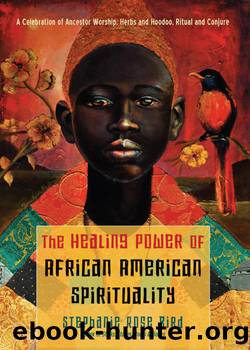
Author:Stephanie Rose Bird
Language: eng
Format: epub
ISBN: 9781612834672
Publisher: Hampton Roads Publishing
Honoring Trees and Forests
West Africa has so many lessons to teach us. There, the Yoruba people intentionally create wooded areas, called sacred groves, in honor of specific deities. These enclosed, consecrated spaces are fit for use by ancestral spirits as well because they are safe, protected, and indigenous to the area. Some of these spaces are called Igboro-Egun, which means âGrove of the Ancestors.â Another type of grove also exists. This alternate grove is designed to celebrate specific Orishas; for example, Igboro-Osayin is a sacred grove dedicated to Osayin, whom we have discussed previously as Orisha of the Wood and Herbal Magick. You can tell these are sacred places by the trees that occupy their space. Igboro-Egun, for example, hosts omiyolo, iporogun, and atori, which are some of the Yoruba's most sacred trees/shrubs.
In many traditional African cultures, respect is paid to the spirits of trees during ceremony and ritual. There are special dances performed at designated times of the year to pay tribute to specific plants, trees, resources, and natural spaces, as well as what we consider the designing of âarts and crafts-â like masks and costumes, all to honor the very large group of living and spiritual beings that we place under an umbrella term ânature.â
In the first chapter, I discussed the wonder of tree whispering and Jiridon (the science of the trees). Such activities are embraced in Africa and the diaspora, not only by shamans but also by hunters, warriors, healers, artists, and most likely avid gardeners.
Groups of people of African descent pay homage to trees and their attendant spirits differently. For example, in some groups, before cutting down a tree, it is thought that one must address tree spirits, which can be good, bad, neutral, or confused by nature. Acknowledging these types of spirits encourages them to stay in their selected spaces rather than moving into the human domestic space. Disturbing without respect brings bad or confused energy into the household or even into specific individuals in the home. Therefore, it is important to maintain a boundary between certain trees and domestic space, a concept well understood in Africa and the Caribbean. This is especially true when it comes to the tamarind, one of the African diaspora's most spirit-oriented fruit trees. Tamarind, being especially hospitable to spirits, must be treated with ultimate respect when planted near the home.
Over centuries, indigenous Africans have lived close to their environment. Their holistic, traditional, scientific knowledge, which is drawn from experimentation, observation, and innovation, continues to evolve. Taboos, based on spirituality and traditional value systems, have protected the biodiversity of various communities in Africa.
Download
This site does not store any files on its server. We only index and link to content provided by other sites. Please contact the content providers to delete copyright contents if any and email us, we'll remove relevant links or contents immediately.
| Anthropology | Archaeology |
| Philosophy | Politics & Government |
| Social Sciences | Sociology |
| Women's Studies |
Born to Run: by Christopher McDougall(7127)
The Leavers by Lisa Ko(6948)
iGen by Jean M. Twenge(5416)
Sapiens by Yuval Noah Harari(5372)
Spare by Prince Harry The Duke of Sussex(5197)
The Kite Runner by Khaled Hosseini(5180)
Machine Learning at Scale with H2O by Gregory Keys | David Whiting(4313)
Bullshit Jobs by David Graeber(4191)
Never by Ken Follett(3957)
Goodbye Paradise(3810)
Livewired by David Eagleman(3775)
Fairy Tale by Stephen King(3399)
A Dictionary of Sociology by Unknown(3085)
Harry Potter 4 - Harry Potter and The Goblet of Fire by J.K.Rowling(3074)
The Social Psychology of Inequality by Unknown(3031)
The Club by A.L. Brooks(2926)
Will by Will Smith(2920)
0041152001443424520 .pdf by Unknown(2846)
People of the Earth: An Introduction to World Prehistory by Dr. Brian Fagan & Nadia Durrani(2739)
